

Currency markets move every second of every business day, and somewhere in those constant fluctuations, millions of people around the world see opportunity. Forex trading attracts everyday traders for good reason: it is the world’s largest financial market, with an estimated average daily trading volume exceeding $7.5 trillion, accessible around the clock and open to anyone with an internet connection and the willingness to learn. But accessibility is not the same as simplicity. The foreign exchange market rewards discipline, preparation, and patience far more reliably than it rewards impulsiveness.
If you are new to currency trading, this guide is your foundation. We will walk you through how the market works, what the terminology means, how to choose a broker, and how to take your first steps without putting real capital at risk before you are ready.
Understanding Currency Pairs in the Forex Market
In the forex market, you never simply buy or sell currencies in isolation. Instead, foreign exchange trading involves the simultaneous buying of one currency and the selling of another. This is why currencies are always quoted in currency pairs.
Every pair consists of a base currency (on the left) and a quote currency (on the right). The exchange rates you see on your screen show how many units of the quote currency are needed to purchase 1 unit of the base currency. For example, in the EUR USD pair, the Euro is the base and the U.S. Dollar is the quote. If the market price is 1.0800, it means one Euro costs 1.08 US Dollars.
Major currency pairs, such as USD/JPY or GBP/USD, involve the U.S. Dollar paired against other global heavyweights and typically offer the most liquidity and competitive spreads. Beginners often find it helpful to focus on these before exploring exotic currency pairs, which involve currencies from developing economies and can be much more volatile. Whether you are looking at the Japanese Yen or the British Pound, the goal is to profit from price movements by predicting whether the base currency will strengthen or weaken against the quote.
Essential Forex (Foreign Exchange) Terminology
Forex has its own language, and getting comfortable with the core vocabulary will make everything else much easier to absorb.
Pips
A pip (percentage in point) is the smallest standard price movement in a currency pair. For most pairs, it is a one-digit move in the fourth decimal place. So if EUR/USD moves from 1.0850 to 1.0851, that is a one-pip movement. Pips are how traders measure gains and losses, and understanding pip value is essential for calculating risk accurately.
Lots
Currencies are traded in standardized units called lots. A standard lot equals 100,000 units of the base currency. A mini lot is 10,000 units, and a micro lot is 1,000 units. Most retail traders, especially beginners, work with mini or micro lots to keep exposure manageable.
Leverage and Margin
Leverage lets you manage a significantly larger market position than your initial deposit would typically permit. A broker offering 100:1 leverage lets you control $100,000 worth of currency with just $1,000 in your account. That $1,000 is your margin, the initial deposit required to open and maintain a leveraged position.
This amplification cuts both ways. A leveraged position can multiply profits when the market moves in your favor, but it accelerates losses just as quickly when it does not. Beginners should treat leverage with real caution.
Spreads and Commissions
The spread is the difference between the bid price (what a buyer will pay) and the ask price (what a seller will accept). It is effectively the transaction cost on most trades. Some brokers also charge a separate commission per trade. Both reduce your net profit, so understanding and comparing these costs is important before choosing where to trade.
A Simple Example
Imagine you decide to trade forex by going “long” on EUR/USD at 1.1000 with one micro lot (1,000 units). If the closing price rises to 1.1050, the price moved up by 50 pips. For a micro lot, each pip is worth $0.10, resulting in a $5.00 profit. Conversely, if the price drops to 1.0950, you would face a $5.00 loss.
Choosing a Trading Platform and Broker
The broker you choose shapes your entire trading experience, so this decision deserves careful attention. A reliable broker handles your funds, executes your trades fairly, and provides the tools you need to operate effectively in the market.
Regulatory compliance is the single most important factor to verify first. A regulated broker operates under the oversight of recognized financial authorities such as the FCA in the United Kingdom, ASIC in Australia, or the CFTC and NFA in the United States. Regulation means the broker must meet strict standards around capital requirements, fair execution, and client fund protection. Trading with an unregulated broker exposes you to risks that no trading strategy can offset.
Beyond regulation, consider the trading platform. It should feel intuitive, especially for beginners. Industry standards like MetaTrader 5 (MT5) or MetaTrader 4 (MT4) shine here, with features for charting, order types, and real-time data. Look for ones that support technical analysis tools, like moving averages for spotting trends, and economic calendars to track events impacting currency prices. Mobile apps are a plus for trading on the go, given the market’s 24/5 operation.
Other factors worth comparing include the spreads and commissions structure. Competitive spreads reduce costs on every trade, while low or no commissions help profitability. Check available instruments; a good broker offers major currency pairs plus minors and exotics, along with other asset classes if you expand later. Customer support is non-negotiable; responsive teams can guide you through issues, from account setup to technical glitches.
Don’t overlook reviews and research; read what other forex traders say about execution speed and withdrawal processes. Some brokers provide educational content, trading signals, or tools for market analysis, which can boost your skills. Ultimately, the goal is a setup that aligns with your trading style, whether you’re into day trading or longer holds.
TradeQuo offers regulated access to forex markets alongside educational resources designed specifically for traders who are building their foundation. It is worth exploring this platform as part of your due diligence when selecting a broker.
Basic Trading Strategies
Success in the foreign exchange market is rarely about luck; it is about having a repeatable trading strategy. There are two main types of market analysis:
- Technical Analysis: This involves studying charts and price movements. Traders use indicators like moving averages or support and resistance levels to predict future trends.
- Fundamental Analysis: This focuses on economic data, central bank announcements, and interest rates. For instance, positive news about a country’s GDP often increases demand for its currency.
Basic strategies for beginners include:
Trend Following
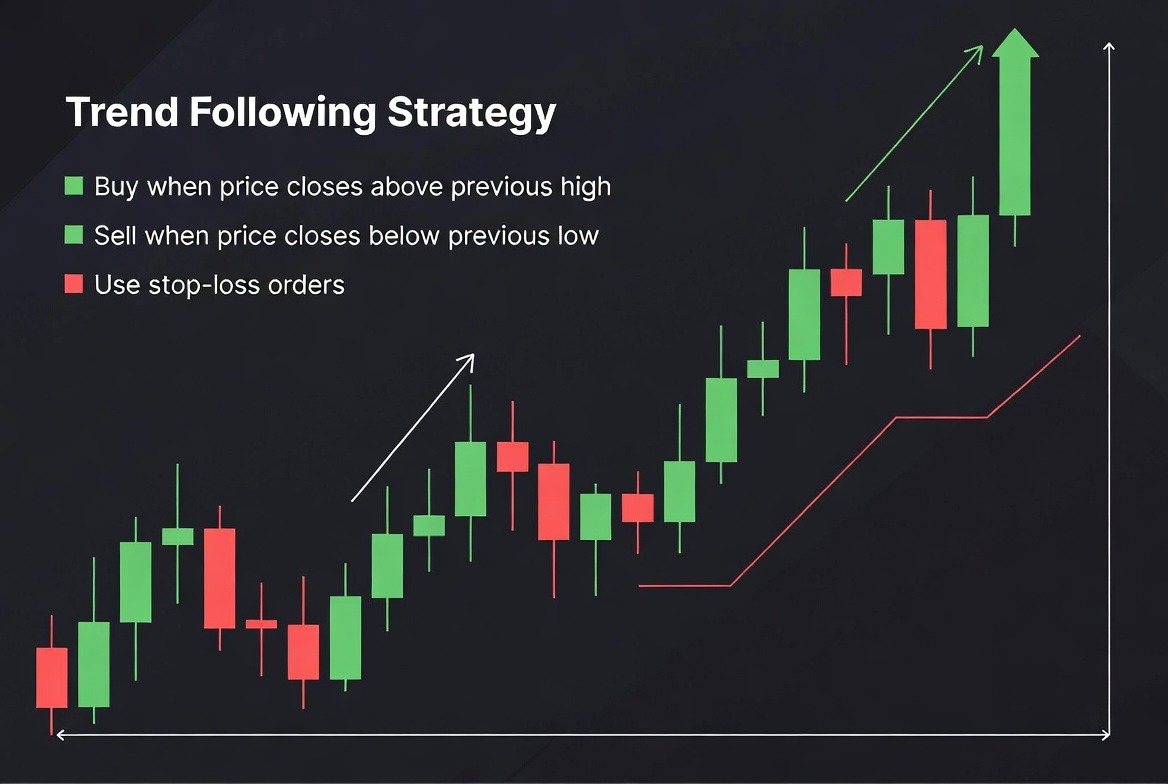
The core idea here is simple: identify the direction the market is moving and trade in alignment with it rather than against it. Traders using this approach look for currency pairs that are making consistent higher highs and higher lows (an uptrend) or lower lows and lower highs (a downtrend). Technical analysis tools like moving averages help smooth out short-term noise and clarify the underlying direction. Many experienced traders follow the principle that the trend is your friend, and it holds up well as a starting framework.
Range Trading
Some currency pairs spend extended periods moving between a defined floor and ceiling rather than trending in one direction. Range traders identify these boundaries, buying near the support level and selling near the resistance level. This approach relies on the pair returning to a middle ground rather than breaking out, which makes it less effective during periods of high volatility or major economic announcements.
Swing Trading
Swing trading involves holding positions for days to weeks, aiming to capture medium-term price movements. It does not require constant monitoring, which makes it accessible to people who cannot watch the market throughout the day. Swing traders typically combine technical and fundamental analysis, using chart patterns alongside an awareness of economic data and central bank announcements that might drive currency values.
Risk Management Comes First
Whatever strategy you explore, proper risk management is not optional. The 1% rule is a widely respected guideline: never risk more than 1 to 2 percent of your total account balance on a single trade. Using stop-loss orders to cap potential losses on every trade and take-profit orders to lock in gains are standard practices among successful traders. Emotional control matters just as much as any technical approach. Fear and greed are responsible for far more trading losses than market conditions ever are.
Practice Trading Currencies with Demo Accounts
One of the most valuable steps any beginner can take is opening a demo account before committing any real capital. A demo account gives you access to live market conditions using virtual funds, which means you can practice a strategy, learn the platform, and make mistakes without any financial consequences.
Think of it as a risk-free environment for genuine learning. You can place trades, experiment with different lot sizes, test how stop-loss orders behave, and get a feel for how currency prices move throughout the day, all without putting anything at risk. The psychological stakes are lower, which actually helps you learn the mechanics properly before real money introduces a different kind of pressure.
Most forex brokers recommend spending anywhere from three to six months in the demo environment before moving to a live trading account. Use this time purposefully. Follow a consistent routine, keep a trading journal that records your entries, your reasoning, and your outcomes, and treat each session as genuine practice rather than casual exploration. The habits you build in a demo account tend to carry over, so building good ones from the start matters.
When you do transition to live trading, consider beginning with a micro or cent account rather than a full standard account. The emotional stakes differ significantly once real money is involved, and starting small helps manage that psychological shift.
Start Trading Forex by Developing a Trading Plan
Trading without a plan is essentially gambling. A trading plan is the document that defines your approach, protects you from impulsive decisions, and gives you something concrete to evaluate and improve over time.
Set Clear Goals
Start forex trading by defining what you want to achieve and over what timeframe. Vague ambitions like “make money from forex” are not useful. Specific, measurable goals, such as achieving a consistent win rate or growing an account by a defined percentage over six months, give you something to work toward and measure progress against.
Define Your Risk Tolerance
Before you trade a single live position, decide how much capital you are willing to lose in total, and how much you are comfortable risking on any individual trade. This is not pessimism; it is realism. Knowing your limits in advance prevents you from making desperate decisions after a losing streak.
Choose Your Market Focus
New traders generally do better when they concentrate on one or two major currency pairs rather than spreading attention across many instruments. Depth of understanding in a small number of markets almost always outperforms shallow knowledge across many.
Write Down Entry and Exit Rules
Your plan should specify the conditions that will prompt you to enter a trade: what technical signals you are looking for, what fundamental context you require, and what the market needs to show before you act. It should be equally clear about when you exit, both in profitable scenarios and losing ones. Rules that exist only in your head tend to dissolve under pressure.
Review and Adapt
A trading plan is a living document. Review it regularly using your trading journal as evidence. What is working? What is consistently losing? The goal is continuous refinement based on actual results rather than theory.
Market sentiment shifts, interest rates change, and economic data surprises the market regularly. Traders who adapt their plans in response to real evidence tend to develop lasting forex knowledge over time.
Conclusion
Forex trading offers a genuine opportunity, but it rewards preparation above everything else. Start trading forex by understanding the market mechanics and vocabulary. Choose a regulated broker with a reliable trading platform. Practice in a demo account until your approach is consistent. Build a trading plan that reflects your goals, your risk tolerance, and your market focus, and stick to it with discipline once you go live.
TradeQuo provides educational resources to support traders at every stage of their forex trading journey, alongside regulated account options for when you are ready to move from practice to live markets. Visit the educational portal to keep learning, and explore account-opening pages when you feel prepared to take the next step.

